Urchin
Solo
Nov 2022, Nov 2024
They tried to hide from the war. It found them anyways.
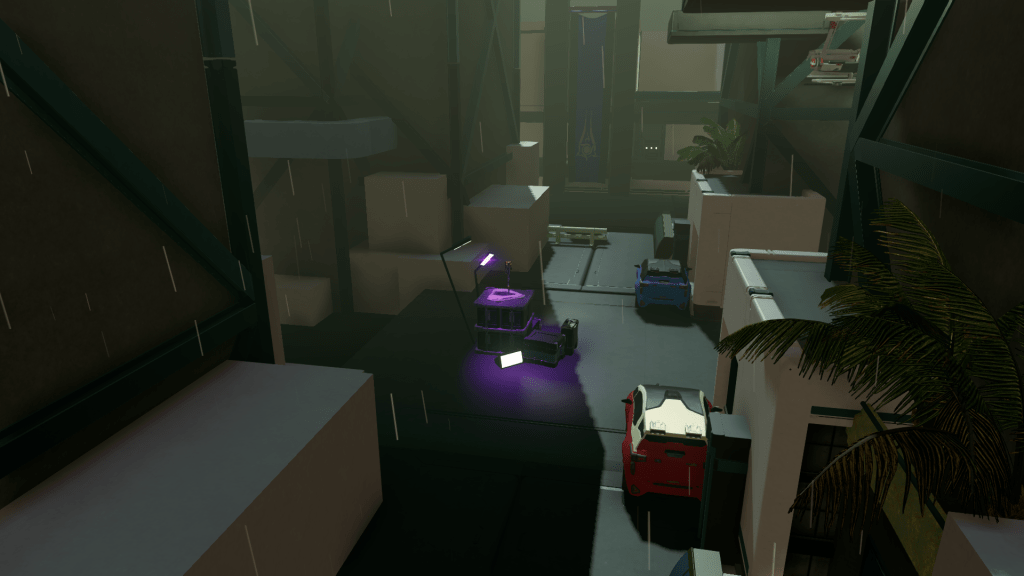
This 2v2 Slayer map for Halo 5 Forge is designed for high-octane, close-quarters skirmishing. I took this level from concept to completion in the Forge engine. I came back to this project in 2024, two years after its initial production period, to highlight the evolution of my design sense and workflow over that period.
Level Design
Responsibilities:
- Solo project, from concept to creation.
- Paper maps for review and greenlight.
- Whitebox using engine-provided primitives.
- Balance weapons and power-up placement.
- Lighting and visual effects for the level.
Production
I wanted to explore a facet of the Halo setting that often goes unseen — civilian areas. Vanilla Halo 5 features few maps set in cities or other populated areas; I saw an opportunity to expand on those ideas for a settlement of refugees, displaced by the universe’s frequent wars.
- Urban areas in real life tend to be more intimate, featuring narrow alleyways and dense corridors. This translated to two core principles:
- (i) map knowledge should be very valuable, allowing players to express that knowledge in the form of pathing options and movement sequences.
- (ii) fights should feel scrappy, in this case meaning close-ranged and with limited resources like ammo.
- The map was a standard three-lane, mirrored for each team. The sidelines are designed for opposite purposes — one side is placed at high ground, defensible with access to the center canopy; the other is open and on very low ground, making it more dangerous but having a powerful shotgun pickup.
- Adding a canopy over the middle lane helped create an overhang effect, which makes the player feel small and claustrophobic — very suitable for dense spaces. This had the additional effect of creating counter-play around the strongest pick-ups, as the gravity hammer and shotgun could not be used without closing the vertical distance.
I had built this map before I had found my stride with my workflow; as such, I did a poor job of documenting my process for future reference. I took a different approach to mapping, where I would go back and forth between drawing the map on paper and whiteboxing it in level to make adjustments.
In Retrospect
If I could change anything about this map’s original sprint, I would take a more paperwork-first approach to the map. I relied too much on spontaneous inspiration while building the level, which made me prone to burning out. One of the benefits of starting with documentation is that it puts a gap between my ability to work and my ability to be creative.
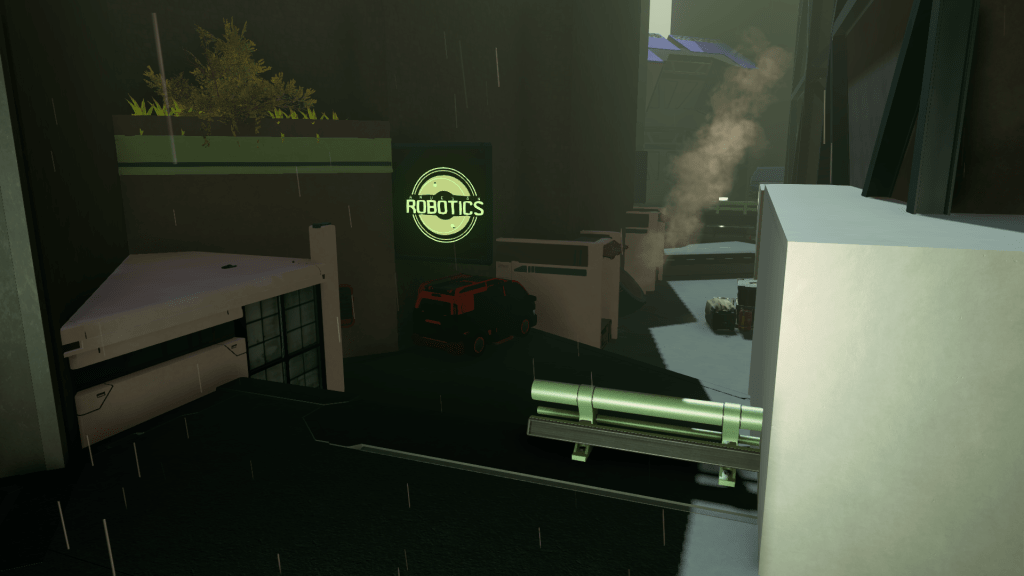

Screenshots of the level from 2022.
Reflecting
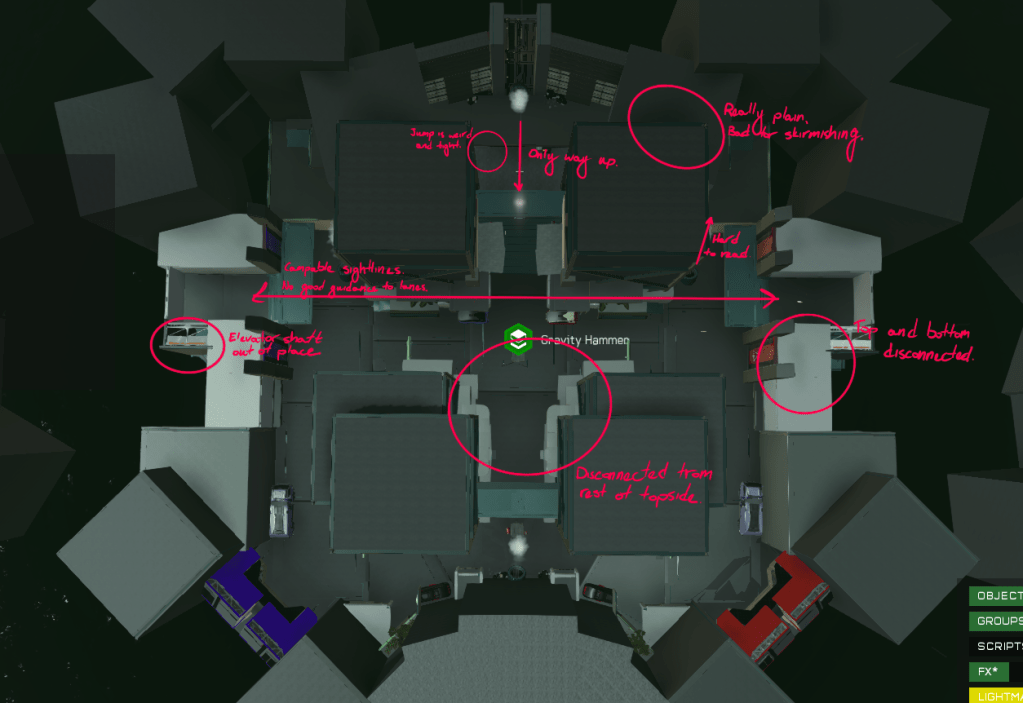
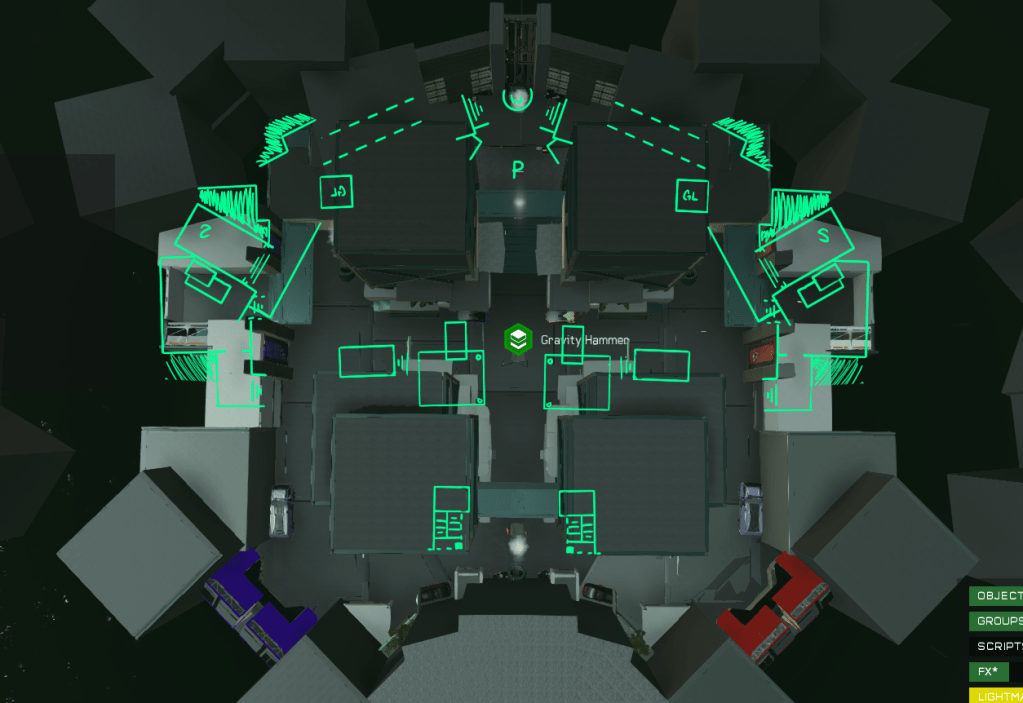
In 2024, I was able to revisit this project. My goal in reworking some of this level was to highlight the changes in my design process. I took screenshots of the original level in top-down view, which I then pulled into Procreate. There I sketched over the level, identifying major flaws and drafting ways to resolve them. While I didn’t commit to a full re-implementation, I tried implementing some of these solutions in engine; I used what I noticed there to create a final-draft map, which best reflects my updated design sense.
Engine Dissonance
The biggest issue with the original iteration of the level is an incompatibility in my level’s vision and the capabilities of the Halo 5 forge engine. Halo 5 lacks many important design tools, such as functions for scaling or applying mirrored symmetry. Additionally, the included environment kit does not accommodate for small spaces or concave geometry. Making major changes to the level’s vision helped bridge the gap between myself and the engine.
- The lack of mirror symmetry in Halo 5 forge was a major blocker. Switching to rotational symmetry would massively improve production speed.
- To accommodate rotational symmetry, side lanes would be cut in half and mirrored in both side lanes. This has the nice effect of making the area look more natural to the setting.

 Sylvie Gesling