Making Summoner’s Rift accessible for more players, regardless of their ability.


OBJECTIVE

Design and pitch an update to League of Legends to address an accessibility concern in the game.

The design process for this patch was straightforward. In addition to my skills as a designer, this exercise was an opportunity to apply my insight as a motor-disabled fan of League. The guiding principles of this update were as follows:

  • (i) changes needed to provide new access to existing systems, without undermining existing forms of challenge within them.
  • (ii) changes needed to be fair and responsive for every player, whether disabled or able.
i. Identifying the Concern

The Concern

The minimum expectation for players is that they can accurately and quickly aim the mouse. Not every player can meet that expectation.

I’ve found it useful to consider the “minimum ability” that a designer anticipates players will have. It highlights the discrepancy between the audience the designer thinks they will have versus the audience that they actually have.

Pain Point: Latency. “Motor Latency” – The delay between deciding to do an action and the action being inputted. After deciding to act, your brain must pass instructions to your muscles through the nervous system. Dysfunction in any of those systems can create additional latency. League plays in real-time; motor latency directly affects the number of actions a player can make versus their opponent.
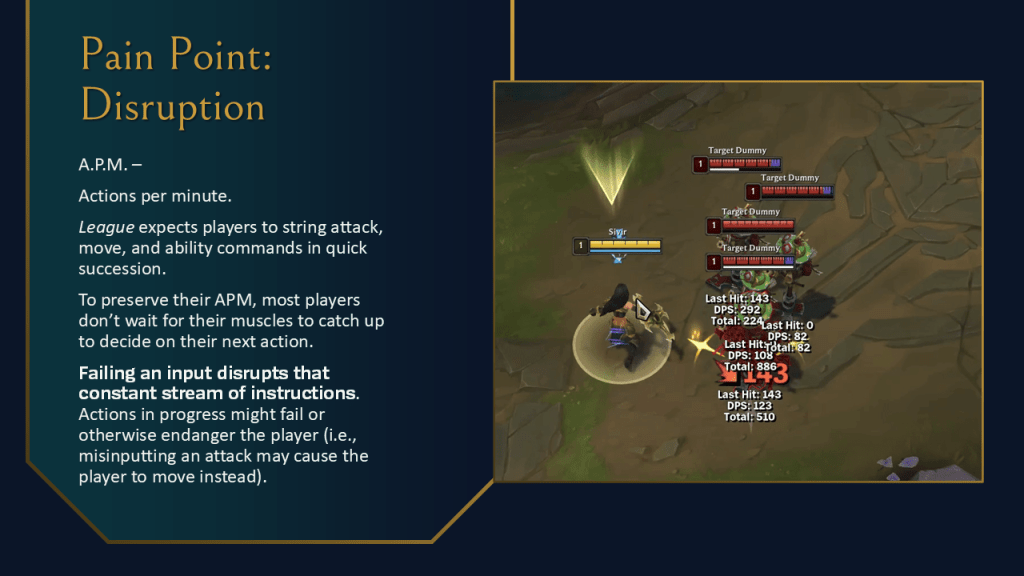
Pain Point: Disruption. A.P.M. – Actions per minute. League expects players to string attack, move, and ability commands in quick succession. To preserve their APM, most players don’t wait for their muscles to catch up to decide on their next action. Failing an input disrupts that constant stream of instructions. Actions in progress might fail or otherwise endanger the player (i.e., misinputting an attack may cause the player to move instead).
Pain Point: Fatigue. Maintaining high APM requires constant and repetitive movements. Even for able-bodied players, sustaining high APMs can be painful, exhaustive, or permanently damaging. Motor or cognitive disabilities can accelerate and amplify those issues. The impetus to maintain high APM not only has the potential to cause lasting harm; it discourages disabled players from engaging with the game or developing positive associations with the property.
ii. Anticipating Challenges

To make robust decisions about design, it’s important to anticipate complications within the space. MOBAs are a highly competitive genre; I needed to get ahead of any systems impacts my changes would have. Specifically, right-click interactions compliment existing systems, like the move speed and character size stats.
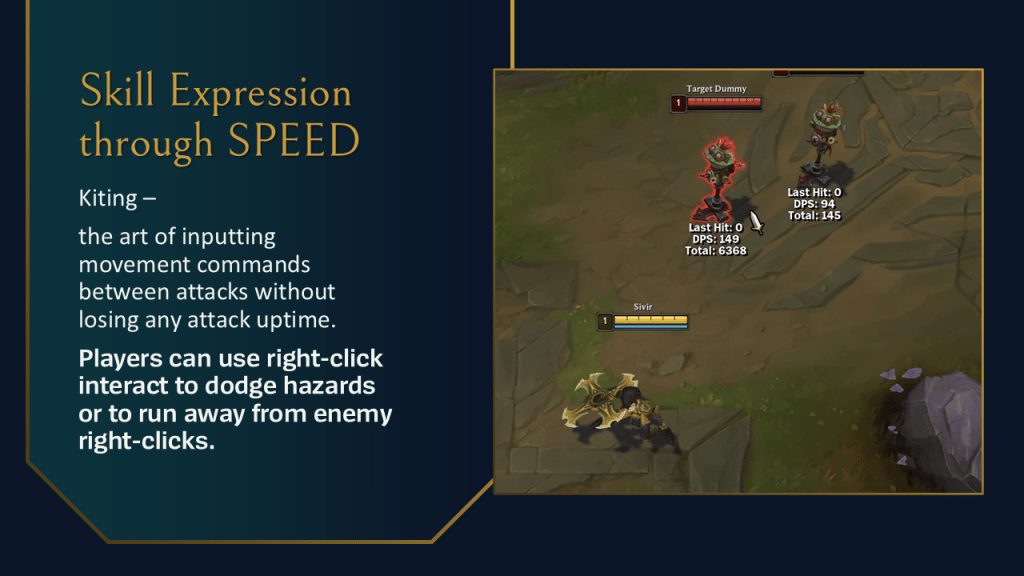
Skill Expression through SPEED.
Kiting – 
the art of inputting movement commands between attacks without losing any attack uptime.
Players can use right-click interact to dodge hazards or to run away from enemy right-clicks.
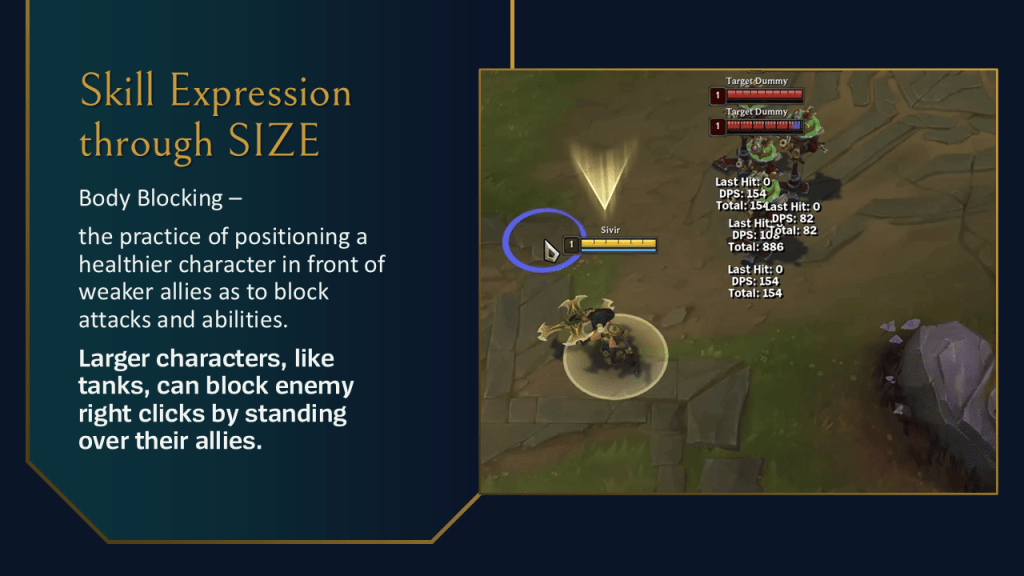
Skill Expression through SIZE.
Body Blocking – 
the practice of positioning a healthier character in front of weaker allies as to block attacks and abilities.
Larger characters, like tanks, can block enemy right clicks by standing over their allies.

On top of that, League already has the attack-move command; inherited from ancestors in the genre, the attack-move command allows players to attack without aiming. However, attack-move isn’t without flaws.
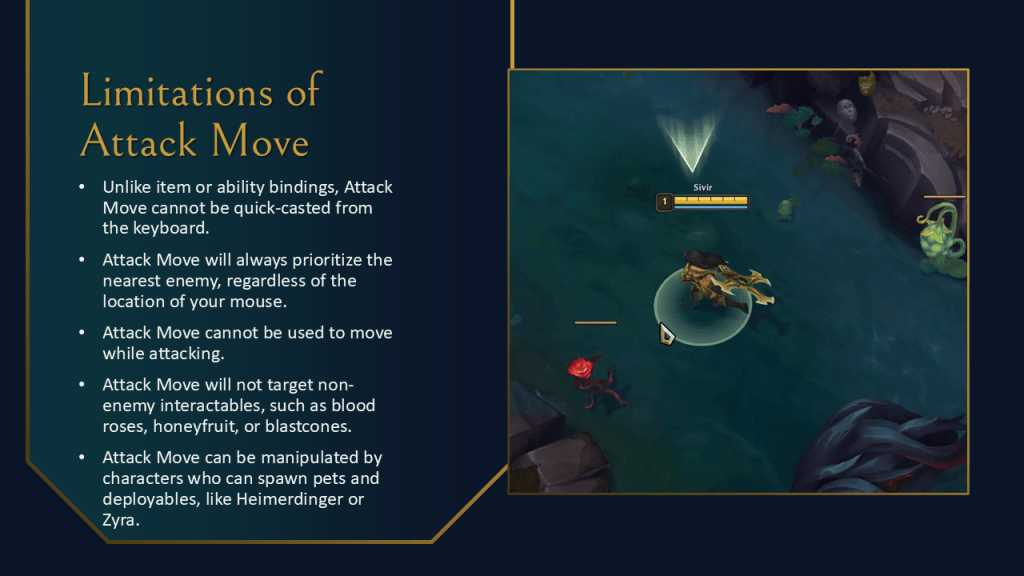
Unlike item or ability bindings, Attack Move cannot be quick-casted from the keyboard.
Attack Move will always prioritize the nearest enemy, regardless of the location of your mouse.
Attack Move cannot be used to move while attacking. 
Attack Move will not target non-enemy interactables, such as blood roses, honeyfruit, or blastcones.
Attack Move can be manipulated by characters who can spawn pets and deployables, like Heimerdinger or Zyra.
iii. Proposing a Solution

My favorite part of this solution is that it’s elegant. By changing the way that the attack-move command handles targeting, we expand its functionality without adding a whole new mechanic to the game. That fact is huge, both as a player and a designer:

  • Reusing an existing mechanic allows us to mitigate some of the production costs for adding actions.
  • Players likely already have the keybind for attack-move still available on their keyboard; they can start using the new system without making any changes to their keyboard layout.

On top of that, we have full control of how “opt-in” this mechanic is. In my pitch, I propose a slider to control the precision of the system; beyond that, we can also add a toggle in the settings for switching to the legacy system altogether.
Attack Move is a suitable foundation for an accessibility feature, but it fails on two accounts.
By always targeting the nearest enemy, it removes the opponent’s agency to use mobility or character size to protect themselves or allies.
By always targeting the nearest enemy, it removes the player’s agency to decide which target to prioritize.
Overhauling the Attack Move command means finding ways to give players agency, regardless of their settings.
Attack Move no longer targets the nearest enemy to the player. Instead, it targets enemies near the position of the cursor.
When multiple enemies are near the cursor, it polls the distance to each enemy in range and chooses the closest. Some stats will modify the distance reported to make them easier or harder to hit.
Players can increase or decrease the range of the area polled in their settings; larger areas make errant clicks more lenient, while smaller areas allow for more precise target selection or movement.
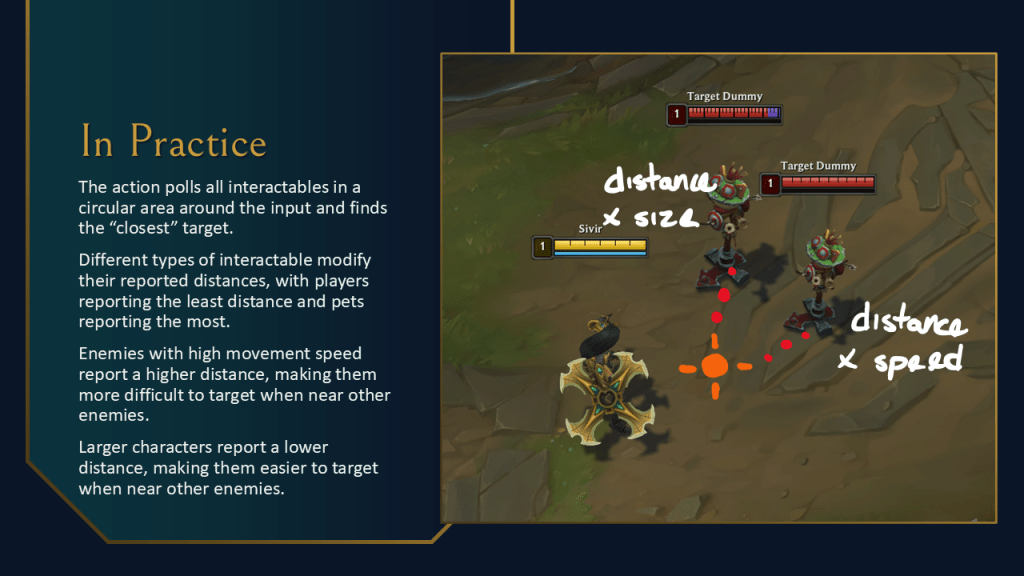
The action polls all interactables in a circular area around the input and finds the “closest” target.
Different types of interactable modify their reported distances, with players reporting the least distance and pets reporting the most.
Enemies with high movement speed report a higher distance, making them more difficult to target when near other enemies.
Larger characters report a lower distance, making them easier to target when near other enemies.